
Oral Minoxidil vs Topical: Why Patients Switch
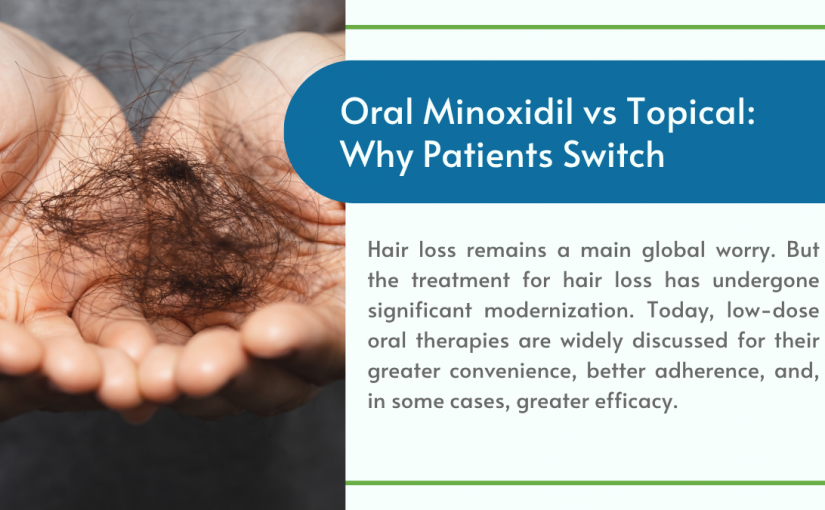
Hair loss remains a main global worry. But the treatment for hair loss has undergone significant modernization. Today, low-dose oral therapies are widely discussed for their greater convenience, better adherence, and, in some cases, greater efficacy.
Topical minoxidil (Rogaine) is a standard, FDA-approved prescription for early-stage hair loss. But due to growing interest in oral medications, the off-label use of oral minoxidil for hair loss is also being considered. This has led to a debate over oral minoxidil vs topical minoxidil.
If you’re confused about which form of minoxidil will work best for you, go through this blog that explores the differences between oral and topical minoxidil. Understand why patients shift from standard minoxidil solution to minoxidil tablet and how you can ensure a safe switch.
Why People Are Quitting Topical Rogaine?
Most hair loss patients are quitting use of minoxidil solution and trying oral minoxidil due to the following reasons:
- The Routine Burnout- A standard minoxidil regimen requires twice-daily application for months or years, which leaves patients mentally drained, especially when hair growth is slow.
- The Aesthetic Concern– A topical minoxidil, whether in liquid or foam, leaves the hair stiff, greasy, or flat. As a result, patients who need regular hair styling for work often feel frustrated and have low social confidence.
- Scalp Irritation: Liquid minoxidil contains propylene glycol, which triggers redness, flaking, and intense itching of the scalp if the area is sensitive. This scalp discomfort has led many patients to skip or avoid topical minoxidil application.
- Poor Compliance: The routine burnout, effect on hair quality and styling, and scalp irritation have led to frequent misses of the minoxidil application, thus reducing its overall effectiveness. Thus, their minoxidil treatment results either remain level or reverse, probably worsening hair loss over time.
This cycle is the major driver of patients searching for oral minoxidil vs. topical.
Oral Minoxidil vs. Topical: Which Grows More Hair?
When comparing oral minoxidil vs. topical, the ultimate question is always: Which grows more hair?
The answer comes down to how your body activates the drug.
- The Topical Limitation: Topical minoxidil requires a specific scalp enzyme called sulfotransferase to become active. Clinical studies reveal that roughly 50% of patients lack optimal levels of this enzyme, leading to minimal or no hair growth. Because absorption is strictly local, regrowth can be slow, patchy, or less dense.
- The Oral Advantage: The liver completely bypasses this scalp bottleneck by processing oral minoxidil systemically. It reliably converts the medication into its active metabolite, ensuring a predictable, consistent response.
Because of this superior systemic absorption, most dermatologists find that oral minoxidil delivers faster, more uniform results across the entire scalp. For non-responders to topical treatments, the oral pill serves as a far more reliable solution for hair loss and thinning.
Is the Minoxidil Pill for Hair Loss Safe to Take?
The current minoxidil pill for hair loss was previously referred to by the brand name Loniten. This oral minoxidil has FDA clearance for severe hypertension at high doses, ranging from 10 mg to 40 mg.
In dermatology, oral minoxidil is prescribed for hair loss at low or microdoses, typically 0.625-2.5 mg daily. The low dosage contributes to a better safety profile. Generally, reported side effects are mild and include temporary ankle swelling, hypertrichosis (unwanted hair growth), and occasional mild dizziness, all reversible with dose adjustments.
The off-label use of oral minoxidil is usually not safe for every hair loss patient, especially if they are pregnant or breastfeeding women or those suffering from hypotension, kidney disease, or uncontrolled heart conditions.
Therefore, in any case, a proper medical evaluation is essential before switching from topical minoxidil or starting intake of oral minoxidil.
How to Switch to Oral Minoxidil Safely?
There is a need for a structured approach, guided by a dermatologist.
If topical minoxidil is abruptly stopped and oral minoxidil is started, massive hair shedding may be a concern. In most clinical discussions, this is tagged as the oral minoxidil shedding transition phase. It happens because hair follicles reset their phase in the hair growth cycle.
To avoid this, dermatologists recommend:
- Gradual transition protocol: It involves starting with low-dose oral minoxidil therapy while gradually reducing topical minoxidil application. This helps minimize the risk of shock, hair shedding, and stabilizes the hair growth cycles.
- Resetting of the timeline: The switch from topical to oral minoxidil will reset the hair growth cycle, and so the visible hair growth will take 3 to 6 months.
- Medical supervision: The transition to oral minoxidil requires medical supervision by a licensed dermatologist. Blood pressure and overall health need to be monitored to avoid serious side effects.
Key Takeaways
Minoxidil is an effective solution for early-stage hair loss, available in two forms: topical or oral.
Topical minoxidil is the standard, FDA-approved medication for hair loss treatment, available in specific strengths.
Oral minoxidil is used off-label for hair loss because it is more convenient, causes no scalp irritation, and provides uniform, faster, more aesthetic results.
Most patients who poorly comply with topical minoxidil therapy consider switching to oral minoxidil. That’s usually when they find minoxidil liquid or foam not helpful after consistent use for 6-12 months.
A sudden switch to oral minoxidil can cause massive shedding. A gradual transition under medical supervision is necessary to reduce shedding.
Shedding during transition can occur after 2-4 weeks of starting oral minoxidil therapy and lasts for 3-6 weeks.
Consistent intake of low-dose oral minoxidil for 3-6 months can provide visible hair regrowth.
FAQs
Oral minoxidil provides more uniform scalp coverage because it acts systemically. In the case of topical minoxidil, effectiveness depends on scalp absorption and enzyme activity. The best option can vary from patient to patient, based on their assessment and the mechanism of the medicine.
One can experience temporary hair shedding after switching due to changes in the hair cycle. This happens because minoxidil shifts resting hair follicles into an active growth phase simultaneously. This shedding is normal, temporary, and signals that the medication is working.
For hair loss, dermatologists prescribe low-dose oral minoxidil ranging from 0.625 mg to 2.5 mg daily for women and up to 5 mg daily for men. These microdoses effectively stimulate hair growth while drastically lowering the risk of systemic cardiovascular side effects.
Yes. You can safely buy oral minoxidil online through licensed international pharmacies like MedsEngage. Because minoxidil is a systemic cardiovascular medication, legitimate platforms will always require a valid doctor’s prescription to prevent dangerous side effects or misuse.
Because oral minoxidil works systemically throughout your entire bloodstream, in certain cases, it can cause hypertrichosis, leading to unwanted facial or body hair growth. This common side effect is dose-dependent and typically reverses if your doctor adjusts your daily prescription to a lower strength.
Yes. Some dermatologists recommend combining oral and topical minoxidil to maximize hair follicle stimulation for non-responders. However, you must use this approach only after dermatological guidance to manage your blood pressure and prevent excessive side effects.